Episode Transcript
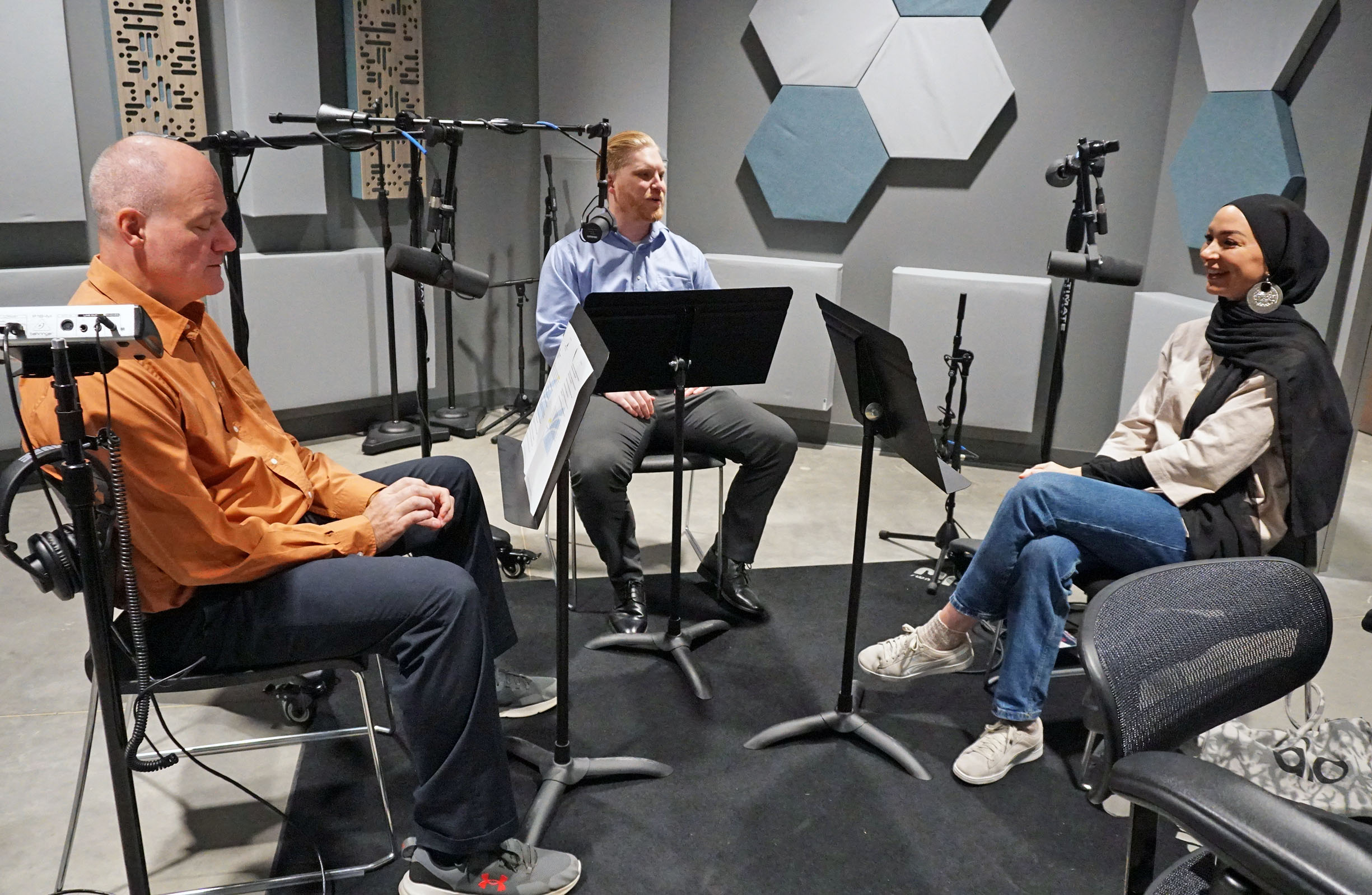
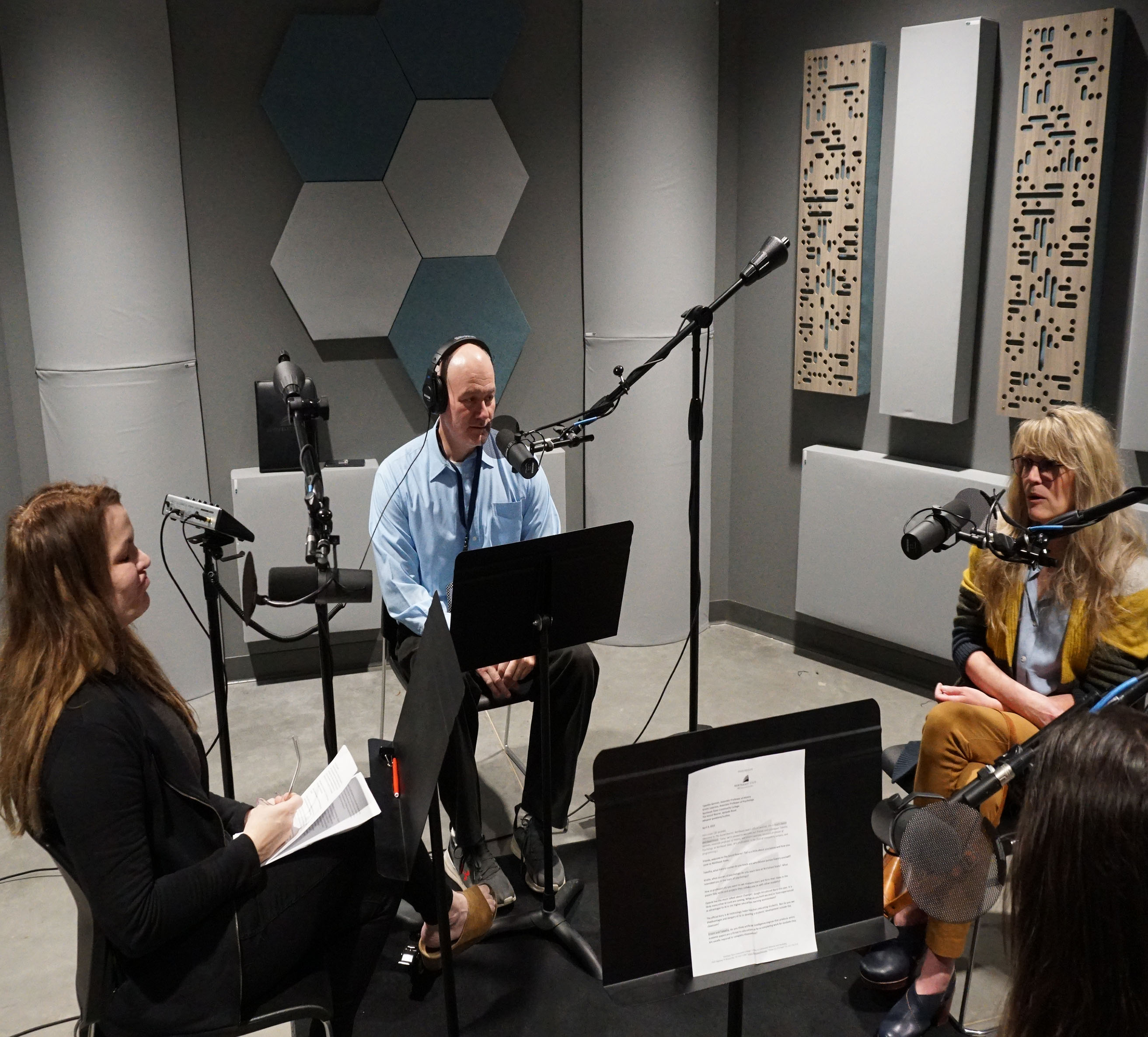
[00:00:06] Speaker A: Hello, friends, loyal listeners and bears everywhere. Welcome to The Sound Bearier Podcast, the official podcast of Northeast State Community College. My name is Tom Wilson. I'm one of your co hosts today along with Mackenzie Moore-Gent. We're coming to you from the Entertainment Technology studio here at the Blountville campus today for this episode.
So, you've got to get an X-ray. Fell down the stairs. Something happened at the ball field. Ow, that leg. Your arm hurts. Who's gonna do that for you? X-ray technologists, that's who. Northeast State has a new Radiologic Technology program, a two-year degree program we started here at Northeast State. And today as our guests, we have instructor Ivan Kennedy and soon-to-be graduate Leslie Smith, one of the first students coming through the Radiologic Technology cohort of students for the semester. And our first graduating class is coming up this spring. Ivan, Leslie, welcome to The Sound Bearier.
[00:01:02] Speaker B: Thank you very much. Glad to be here.
[00:01:03] Speaker A: Ivan, this first kind of question is for you. This is of course an entry-level program for X-ray technicians, or X-ray technologists, as we say. It's kind of the jumping-off point for that. How did you come to the program and get involved with becoming an instructor?
[00:01:19] Speaker B: Well, I have a long history. I graduated from East Tennessee State's program back in 1982. So I've been in this for almost a half century. Worked in all different modalities, started with X-ray, grew into CT, MRI. I'm a radiologist assistant, and then I've been in education for radiologic technology since 2004. I was previously at South College in Knoxville and the new program here lost its program director about three months into the first cohort. And they called me and I was available. It worked out perfectly for me. And so I've been here since April 1st of last year and I'm excited to be here. It's a good opportunity here in Upper East Tennessee, where I'm from, anyway, so.
[00:02:04] Speaker A: Excellent.
[00:02:06] Speaker C: Leslie, what brought you to Northeast State, and what led you to pursue this program?
[00:02:14] Speaker D: So I'm a military veteran and a mom. Took a 14-year stay-at-home mom break when the kids got older. I got a job as a CNA at the hospital Holston Valley Medical Center working on oncology.
Really enjoyed what I did, but I wanted to get a little more hands-on with the patients, you know, diagnostic imaging happened to come up with Northeast State, so I applied, interviewed, got accepted, and here we are.
[00:02:42] Speaker C: Wow. I'd just like to mention that stay-at-home mom break. Yeah, quotation marks around that, I'm assuming. And so what has the program been like for you? Could you tell me? A day in the life of a Radiologic Technology student.
[00:02:55] Speaker D: So first two semesters you'll do didactics for the three days a week, and you'll do clinicals two days a week. That does change halfway through the semester. And then we do clinicals three days and then didactic two days, classes, pretty much books, a lot of hard work, a lot of anatomy, physics, and then we do hands-on clinical at the hospital. And we're also in like HMG outpatient facilities as well. So we, you know, basically just learn all the different positionings, you know, to get the most diagnostic images for the patients.
[00:03:27] Speaker C: Very hands-on. And you're getting that experience before you're, I guess technically working in the field. So, are you working with another radiologic technologist when you're in the clinicals or what do the clinicals look like?
[00:03:40] Speaker D: Sure. So pretty much any radiologic technologist you can kind of get up and go with, they'll show you how they do it. But once you're competent and you show that you're able to do those exams, they pretty much just send you on and they're obviously still watching you in earshot. But you're going to get the patient, you're bringing them back, you're doing the patient care aspect of it and then you're doing the X-ray just like if they weren't there.
[00:04:06] Speaker C: That's awesome.
[00:04:07] Speaker D: Long days, long weeks, 1300 hours of clinical time. Yes.
[00:04:14] Speaker C: Wow.
[00:04:15] Speaker B: In four semesters.
[00:04:16] Speaker D: In four semesters, yeah.
[00:04:18] Speaker A: What was that first semester like? Kind of getting adjusted to fellow students, the faculty, what was it like? Everybody getting acclimated to each other in a brand new program.
[00:04:28] Speaker D: So I will say resilience is what we learned first out the gate. You know, every new program has obstacles, obviously, but I think just like when you're working in X-ray, no patients, the same, no situation, you know, scenario is the same. So you have to learn to overcome, adapt. We surely did that the first two semesters. We did have great leadership. Northeast State's very supportive. We did have an instructor, Stan Hickam. He's been there since the beginning. He's been a wonderful asset to our program.
Then we had Mr. Kennedy and Mariah Cole come in, who have been completely supportive as well. Great leadership. Our faculty's been amazing trying to help us, like I said, overcome those obstacles when they came in. You know, where we were at the first two semesters, Al ditto.
[00:05:16] Speaker B: The resilience of this group of students is phenomenal. Coming in and seeing the situation as it was, I was very proud of them for their stick-to-itiveness. We didn't lose anyone right at the transition time. Everyone stayed. One did leave at the end of the first semester, but he just decided it was something different he wanted to do. So this group of students has grown together as a cohort, more so probably than a lot of cohorts because of the adversity. And they have really done fantastic.
[00:05:49] Speaker A: How many students do we have going through this first cohort?
[00:05:51] Speaker B: Currently 19.
[00:05:53] Speaker A: 19.
[00:05:54] Speaker C: Okay, could you dive in a little bit to like, I know, CT scans, MRIs, mammography. Is that all encompassing Radiologic Tech or am I correct on that?
[00:06:11] Speaker B: Our program is Radiologic Technology, which is an X-ray technologist.
And that's all you're trained to do is X-ray. Now that is a primary certification that you do through the American Registry of Radiologic Technologists. And once you achieve that certification, you can then go into CT scanning.
Mammography is a branch of X-ray, but you still have to have some additional training and certification in that to stay there. MRI, and all of the MRI is totally different. It's magnetic fields and radio waves as opposed to X-rays. So it's something different. But it is a modality of medical imaging. So nuclear medicine, ultrasound, all of those are imaging modalities.
So they can expand into that after getting the entry-level position of a radiologic technologist.
[00:07:05] Speaker C: Okay, awesome. Thank you for breaking that down for me. I'm just, I'm not well versed in this field by any means. So can we talk a little bit about the instruments that are used in classes and out in clinicals too?
[00:07:19] Speaker B: Basically, we have the structure of lecture in the classroom. We have a machine that's installed in our campus, an X-ray machine. And we have a mobile X-ray machine that's used in surgery called a C-arm. It's live X-ray called fluoroscopy. And so we have both of those machines in our lab. And so we learn about it in lecture and they practice it in the lab. Now, we don't actually expose — those machines actually do not make radiation, but they're used to learn to position the patient correctly, align everything to do the procedures correctly, and then they go to the clinic setting and actually do the procedures on live patients, real patients, under the supervision of a registered technologist.
[00:08:08] Speaker C: Are there any exams that you have to take after graduation or before graduation to practice? I know that nursing they'll take the NCLEX.
[00:08:17] Speaker B: Ours is the cert. The registry is what it's called the ARRT, the American Registry of Radiologic Technologists. They have to go take one exam encompassing all of the material covered in the two-year period. And these guys are prepping for that right now. So they're going through boot camp right now to practicing exams and recalling and reviewing material in order to be able to pass that exam.
[00:08:45] Speaker C: Very comprehensive.
[00:08:46] Speaker B: Yes, very comprehensive.
[00:08:47] Speaker A: Wow.
[00:08:49] Speaker C: You'll nail it, you'll crush it. I know you will, but that's still very intimidating. And that's a lot of work.
A lot of work goes into this program. But what are you getting out of it?
[00:09:01] Speaker D: A lot of corrections. Oh, a lot of corrections. We take these exams and Mr. Kennedy has a method to his madness and we're just trying to trust the process.
So it's a lot of work, a lot of material. It's four semesters, so it feels like it's crammed in. But it's doable, you know, if you really put the time and effort in and study, for sure.
[00:09:25] Speaker C: Oh yeah, studying memorization, it's a lot.
[00:09:30] Speaker B: Well, critical thinking is big, to know the concepts and be able to think through scenarios.
Because every patient that comes in front of you is not the same.
Every situation is not the same. So you have to be able to know and then adapt to whatever the circumstances are to be able to accomplish the exam.
It's more. That's why we're technologists. We learn all of this and put it into practice, no matter what the setting is.
[00:09:57] Speaker C: And then also like the results, like just reading the results too. And like I've looked up on screens when they're taking my - rays and I could not tell you the first thing about anything that I see on that screen. It looks foreign, I guess, so to speak, to me. I wouldn't know how to read it. So just knowing that too, there's a lot that goes into that.
[00:10:15] Speaker A: What do X-rays look for? I mean, obviously if you have a broken bone, and maybe those are the most obvious things. But what can an X-ray tell a physician when it's taken at a certain angle? What are they looking for?
[00:10:29] Speaker B: So basically we project a beam of X-ray. It's radiation that is created in the X-ray tube and it passes through the patient.
Some more dense material absorbs the X-ray, others allow it to pass through.
So it creates different shades of gray, demonstrating the anatomy. So the radiologist that interprets that knows what normal anatomy should look like. And so they're looking for something abnormal in the midst of normal anatomy, like the broken arm, that you can see on those. But there can also be other cancerous lesions or different types of pathology that can be demonstrated by an X-ray exam.
[00:11:12] Speaker C: Oh, wow. So you can go in for a broken arm and find something totally unrelated?
[00:11:17] Speaker B: Absolutely, what they call incidental findings. You go in for one thing and they find something else, and that's a good thing that it can be discovered, you know.
[00:11:30] Speaker C: So, how has this technology evolved in the industry?
[00:11:35] Speaker B: A long ways in. During my career, I kind of grew up with this profession. Computed tomography was brand new when I came out of X-ray school. I learned to do that. And then MRI came along. Total different type of physics.
Using radio frequencies and a big magnet to make the protons in the bond jump around and give off a signal.
An ultrasound. Ultrasound's been around quite a long time using sound waves. Nuclear medicine uses a radioactive material that's injected in the bloodstream and it's imaged and so forth. I mean, it's just massive, the amount of information that we get. But it's a great tool.
So it gives the doctors the information to know what's wrong and what they need to do to treat it.
[00:12:23] Speaker A: How hard does it get to get people — and I'm guessing this is part of the whole learning experience — to get people positioned on the table, because it seems to be that you have to get them in a certain position. Everybody has to hold still, and you have to shoot it. And how big of a challenge is that? The second part of that question is, are people scared of X-rays, are people still kind of, like, afraid of X rays?
[00:12:44] Speaker D: Yeah, I think they are. I think people just don't know. So, you know, obviously not knowing something has always put fear in people's positioning. That's part of the clinical aspect of it. You know, like I said, no patient's the same, no scenario's the same. You know, you run into having that dislocated shoulder, and you can't move their shoulder, you know, to get the correct positioning you need. So the X-ray tube does move.
So we can, you know, shoot at an angle. An angle in or, you know, angle away from the body to kind of stick. Still get that same image that we need, as if we were to have the patient rotate their arm in or out.
So we can still obtain those same diagnostic images by just our critical thinking of, okay, well, I need it to be lateral. How do I move that angle of the tube so that I can still shoot it and see that the anatomy is positioned correctly?
[00:13:38] Speaker A: Okay.
[00:13:39] Speaker C: And with clinicals, can we talk a little bit about the partnerships? I know that we had talked a little bit before we started recording, but the partnerships that we have with surrounding health care providers.
[00:13:49] Speaker B: Currently, we have an affiliation agreement with Ballad Health. And so all of the hospitals in the Ballad Health System, from Greeneville, Rogersville all the way up to Bristol, we have students at each of the hospital facilities, multiple students at the larger hospitals. At Holston Valley, they have eight new students and six in the second cohort, the first cohort. So. So down to the small hospital, like at Sycamore Shoals, you know, they have one of our students. Now we share clinical facilities with the other radiologic technology programs in the area. But that's what limits our class size, is the number of clinical spots, because there's a certain requirement for supervision by registered technologists and the amount of machines that are available and patients that are available. And so we have to watch really close on that to maintain the accreditation standards, to make sure that everyone's getting the fair and equitable education process. But we're very thankful to be in with the Ballad Health system, and they're very supportive of our program.
And a matter of fact, a lot of our current seniors work there as what we call an intern.
Even while they're still in the program, they can clock out from clinicals and clock in and go to work with the technologist and make some money while learning additionally, too. So.
[00:15:15] Speaker C: Wow, that is great.
[00:15:17] Speaker B: We do have Holston Medical Group that also takes a student at an outpatient imaging center currently, so.
[00:15:25] Speaker C: Wow. And you had said 1300 hours total. What does that translate to, like, weekly?
[00:15:31] Speaker D: Well, like I said, the first two semesters, you're in clinicals for two days a week.
Typically the day is going to be 7:30 to 4. You do have different shifts that you have to do. So like next week I'm scheduled on after hours. So it's 1 to 9:30.
You'll be in the ER, you rotate. So you'll go from surgery to the ER to the main X-ray department. Just kind of depends on where you're situated.
Second semester, we're in there three days a week, same, you know, kind of hours. 7:30 to 4 is typically the day shift.
Then 1 to 9:30, you know, is the night shift.
So it's a lot of time.
[00:16:15] Speaker C: Yeah, it sounds like it. And like the field, I know that I'm not sure if we were recording when we were talking about you. Leslie, you had said that you eventually want to go into mammography.
[00:16:27] Speaker D: Yes.
[00:16:27] Speaker C: Am I correct in saying so? What does your strategy look like after graduation, taking the exam and then how would you pursue that? Keep the momentum going?
[00:16:37] Speaker D: I mean, I'm already leaning forward, running with this, so looking forward to getting into the mammography program once I graduate and pass the boards.
[00:16:50] Speaker C: And how does being cross-trained help?
Even with some specific, I guess focuses within this industry. How does being cross-trained help you gain skills?With equipment, with the different situations and scenarios and even the people and situations.
How is being cross-trained beneficial?
[00:17:13] Speaker D: I think it makes you more versatile.
I am working in the ER at the hospital CTs right there. So you know, you kind of are able to see what that looks like.
You're able to visualize anatomy in a different way. Just makes you versatile in being able to understand, you know, more of that diagnostic industry-wise.
[00:17:37] Speaker A: I've read a couple things where radiologic technology is one of the fastest growing branches in health care right now. Is it because it provides this jump-off point into other diagnostic testing procedures or what's kind of fueling the drive? Because the demand for this seems very high now.
[00:17:55] Speaker B: The demand is very high. Like I said, I've been in it for over 40 years, and I've seen it kind of ebb and flow, but I've never seen it like it is now.
I think honestly the COVID period, people were nearing retirement age and it got really bad and they decided to go ahead and retire.
And then you've got the regular retirement and the expansion into the other modalities. Generally someone comes into radiography and then they move on to the others eventually and that leaves a vacancy. So we have to continuously be filling those vacancies. And the recruiters from Ballad Health were just recently talking to our first-year students. They're already wanting to get them in the pipeline. They have scholarships available for them as well. And so they're letting them know they're coming in about a week and a half to see the seniors again.
So the outside entities are coming to our program to recruit because the need is so great and I don't see it changing. We'll catch up with it some since this is a new program, it's a new group of people that are coming, but forecast is for it to continually be a need in the medical field for a long time.
[00:19:11] Speaker C: And how are these partnerships created with health care providers out in our community?
[00:19:16] Speaker B: Well, Ballad Health actually came to Northeast State and asked about creating this program.
ETSU has a program and is long-standing. I graduated from there in 1982. It was an associate degree program then. But the Tennessee Board of Regents and everything back in the early 2000s decided that they wanted all universities to have four-year degrees and above and all the less than four-year degrees to go to community colleges.
ETSU obviously wanted to keep their radiologic technology program. So they converted it to a four-year degree, which is not a bad thing. It's good extra education. I encourage our students to continue to go ahead and get the bachelor's degree. And so we're working on an articulation agreement with ETSU where they can just go right into and complete the bachelor's degree program, get a block credit. It's not been signed yet, but it's very close to being completed. That'll be a great thing. But entry level is associate degree and so the community college is set for that. So Ballad Health actually approached Northeast State a few years ago about doing this. And I think they have contributed financially to getting it started and everything. So it is a real partnership.
[00:20:30] Speaker C: Yep. And that's really telling of just I guess the demand for it to have a health care provider want to create this partnership and then open their doors and their facilities. That's awesome.
[00:20:42] Speaker B: Yes.
[00:20:43] Speaker A: The program is based at the Kingsport Center for Higher Education there on our Kingsport campus. And you have a classroom and laboratory space there. And as well as an X-ray machine, as you said, you've got a couple X-ray machines there. Has that worked out pretty well?
[00:20:59] Speaker B: It's worked out very well.
We chose to do a machine that is not energized, meaning it can't actually produce radiation. The tube has been disabled. Otherwise, they would have to put a lot of lead and stuff in the walls as a protection and so forth. And we have. Our students can actually produce X-rays in the clinical setting anyway. So we use the machines to teach them how to move the machines, align everything, position the patient, they practice on each other and so forth. And so it's a valuable tool to have that equipment. And yes, we have a classroom this semester we kind of rotated around to different classrooms, but now they've pretty much set us in a classroom right next door to our lab going forward.
[00:21:42] Speaker A: Oh, excellent.
[00:21:42] Speaker B: Okay.
[00:21:43] Speaker C: And now with the first cohort, they're set to graduate here soon. So what is it looking like for the second cohort?
And they've already started. They started last fall. So that would be the second cohort.
[00:21:57] Speaker B: Second cohort started in January.
[00:21:58] Speaker C: January. Okay.
[00:21:59] Speaker B: During their first semester.
Now when we say start, that's when they're actually admitted to the program. There are prerequisites and so forth that they do. It's a process to get in, very competitive. There were over 250 applicants for 25 spots, and so only about 10% can get in. So those prerequisite classes and so forth that they're taking are very important to do well in those, to get the score up, and we do an interview and so forth as well. Well, to try to make sure that we get the best candidate possible, ready to do this very rigorous program and willing to commit and stay. Because if they leave, we can't just plug someone in. They have to start and finish if there's a vacancy. No one's available to start midstream. They have to start from the beginning.
So far, it's been great.
The second cohort, we have 24.
We did lose one that withdrew because of some medical issues, but we have 24 currently, and they're doing very well.
[00:23:05] Speaker C: And the prerequisites, what are you all looking for in students for Radiologic Technology?
[00:23:11] Speaker B: Anatomy and physiology is the foundation because we're imaging the human anatomy. So anatomy, physiology one is a requirement, a prerequisite. But A and P 2 is also required. It can be done in the program. I don't recommend that. I recommend, if it's all possible, the calendar will let you get it done, to do it beforehand because that has to be done in the first semester in addition to all of the new material that you're learning in the program. It's tough.
We only have one in the second cohort that's doing that. Everyone. I advised going along the way to go ahead and do AP2 and they have done that. The other is math.
Introduction to Health-related Professions.
Those are the solid foundational parts that they need to be prepared to get started in the program.
[00:24:01] Speaker C: So I suppose students could declare maybe a general education major as they're waiting to pursue this cohort.
[00:24:10] Speaker B: Actually, when they come here with an interest in our program, they have what's called an Intro to Allied Health.
And then with the concentration in Radiologic Technology, that's a major that all health-related professions are declared in, that opens up the ability to take those prerequisite courses and then other courses are in there. Even more than that, to keep them full-time for their financial aid responsibilities. And so forth.
[00:24:37] Speaker A: Leslie, what's the oddest thing you've seen doing an X-ray in clinical so far?
Oh, the most fascinating thing, like, wow, that's. I didn't expect to see that probably.
[00:24:50] Speaker D: I mean, all of the, you know, the dislocations, the breaks. I mean, there's a thing that, you know, we have to do two images, 90 degrees from each other, H and a lateral. There's a reason for that for sure.
When you take an image of something that's straight on and we call that ap, it looks completely fine. And then you turn it lateral and it's completely broken in half to where you would never have seen that in that first image.
So those are always, you know, you shoot the first and you're like, well, it's okay. And then you shoot the lateral and you go, oh, my God. Goodness, that's broke.
But of course, we are not radiologists, so we cannot confirm nor deny what we visually see. You know, so we have to just keep our composure and keep right on going.
[00:25:44] Speaker C: I guess that would be. That would be really challenging for me if I were able to read the scan, which I'm not. But in knowing and just not being able to say anything, what are some other challenges that might arise, like, in the field that you just have to overcome and work through?
[00:25:59] Speaker D: You know, just your difficult patients, you know, patients that are, you know, clearly in pain or, you know, there's been some, you know, medical emergencies, cardiac arrest. I mean, when you're in there shooting an X-ray and someone, you know, goes into cardiac arrest, I mean, they're right there.
So we're trained, you know, to do, you know, medical emergency and things like that as well. So it's. It's X-rays, but we're also, you know, a direct patient care line team.
[00:26:28] Speaker C: So that's not something I would have considered. I think with anyone in health care who's working in health care, it really does. And they say it a lot. It's a cliche, but it's true. Like, it takes a special type of person to be able to do that and to stick with it, too.
It's not just like the training and the critical thinking and the knowledge, but just even the everyday, the different situations, you wake up and you never know exactly what you're going to get into or what's going to happen.
[00:26:54] Speaker B: And it's generally far different than what most people in the general public would realize. And so we require our students coming in. Previously, it was optional. This year, with the new cohort coming in 2027, it's required that they spend at least eight hours of observation in a radiology department as part of the admission criteria. And so Ballad Health has worked out a way for them to do that. They can go through an online process, get approved to go and do that. They spend eight hours at least with the technologist watching them, going around with them and seeing all of that, because it's really a lot more involved than the general public would think. And so. And so all we want to do is let them know what they're getting into and be prepared for what to expect. So that's a good tool to help them do that.
[00:27:45] Speaker A: The Radiologic Technologist students are also going to get to have a pinning ceremony, a more common thing than I realize among health care professionals, but that's going to happen this spring. Also. Did the students get to select the design of the pin or how did that come about?
[00:28:01] Speaker B: Our clinical coordinator, Mariah Cole, actually is the one that designed it. She has kind of a background in doing some graphic designing for websites and so forth. And so she actually. And her dad, who is also an adjunct faculty member here with us, they designed that. I let them just do that. And it's a special design for this cohort of students to be their very first pin. It'll probably carry on. The design will carry on, but it was designed with this group of students in mind.
[00:28:34] Speaker A: How special is it to be among this first graduating class just for you and for the whole class?
[00:28:40] Speaker D: I mean, it's amazing. I mean, we've made history not just for Northeast State, but for this program.
It's an honor to be able to be the inaugural first class.
[00:28:53] Speaker C: What have the relationships you formed through this program been like? I mean, these could end up being your colleagues too, out in the field someday, in your work. But what have those relationships and how have you relied on each other, too, for studying, for big tests, for getting through clinicals and just really chaotic hours and all the hard work?
[00:29:14] Speaker D: Yeah, we've all developed a very close relationship.
You know, where we are in different hospitals. You know, we've got Holston Valley, we've got Indian Path, we've got JCMC.
You know, each, I'd say entity has kind of got their. You know, us 6 and Holston Valley have gotten really close. And, you know, each kind of hospital has their own circle, if you will, so.
But as a whole, I mean, we've leaned on each other since day one. And I mean, it's coming to an end. It's kind of getting a little bittersweet.
But we're definitely going to be out in the field working with each other and you know, we'll still come around to the college and see, you know, the faculty and staff, and it's been a very special engagement with everybody.
[00:30:02] Speaker C: That sounds very rewarding. But then like you said, I can understand like the bittersweetness of it all.
[00:30:07] Speaker B: And I've been in this for a long time and I was at one institution for 21 years.
So this is a whole new apparatus for me too. A whole new group of people in a new area, a new program. And I'm looking forward to the future relationships being built in a different area. All of my other students are down around the Knoxville area and so forth. I have lots of great relationships with them. But now we're in a different area and stuff, so it's rewarding for me as well.
An old guy getting a new refreshing start here.
[00:30:41] Speaker C: A well-versed man, an expert in his field.
[00:30:44] Speaker B: Well, I guess you could say that.
[00:30:47] Speaker C: And what does the future of this program look like? Is there anything new on the horizon?
[00:30:53] Speaker B: Well, we are going through the accreditation process for this program currently.
We have a self-study that we'll submit by June 17th and then we go through a site visit and so forth. And so that's the primary focus. Now I've had some inquiries about possibly a CT certificate or an MRI certificate. I'm qualified to teach both of those. I have taught those programs elsewhere.
I've also had requests about possibly sonography or ultrasound and then mammography. So I mean, we're going to look at it and see what the job market needs, and we try to meet the community's needs, of course.
[00:31:32] Speaker A: Ivan, Leslie, thank you both so much for joining us on this podcast. It's been a real pleasure to have you here.
We're super excited that this is the first graduating class. This program is up and running and going strong and we know this class is just going to be the first of many going forward. Leslie, congratulations. Ivan, same to you. Thanks for making this happen here at Northeast State.
[00:31:55] Speaker B: Thank you. It's a privilege.
[00:31:56] Speaker A: Well, friends, that's another episode in the books. We want to thank the Entertainment Technology team here at Northeast State for recording these episodes of The Sound Bearier. Tremendous job as always. Brandon, Jordi will always be making us sound super good. We're on every streaming service. Apple Podcasts, Amazon Music, Google Podcasts, Pandora, Spotify. We're on all of them. Subscribe, leave a review.
Listen, we want to thank all our listeners. And if you want to learn more about the Radiologic Technology program at Northeast State, go to NortheastState.edu, that's NortheastState.edu, and type Radiologic Technology there in the old search engine, and it'll pop right up for you. Learn more about this program and so many others we have here at Northeast State.
Until next time, this is Sound Barrier.