Episode Transcript
[00:00:00] Speaker A: Foreign.
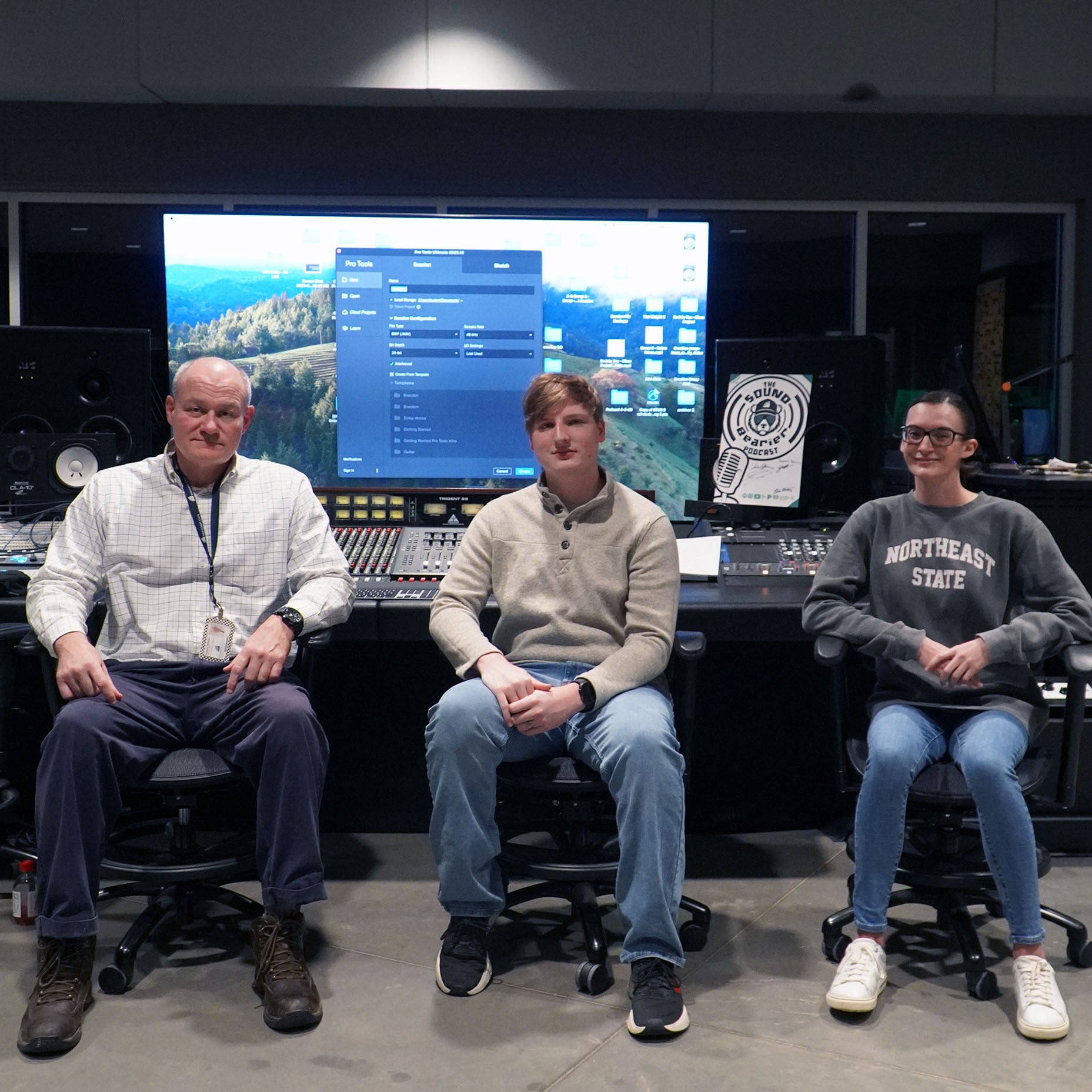
[00:00:08] Speaker B: Listeners and bears everywhere. This is the Sound Barrier, Northeast State's official podcast. My name is Thomas Wilson. I'm your co host today with my fellow co host, Mackenzie Moore. Gent, why don't you come fly with us today in this episode with Mr. Taylor Williams, an alumnus of Northeast State, an aviation technology major, also a graduate of etsu. He's joining us today in the studio to talk about his experience here at Northeast State, his future plans, and his current work with Bell Helicopter. Taylor, welcome to the Sound Barrier.
[00:00:39] Speaker C: Awesome. Thank you for having me.
[00:00:40] Speaker B: Oh, thanks for being here. Now, could you tell us a little bit about yourself, kind of how you found your found your way to Northeast State and what get you interested in aviation technology?
[00:00:49] Speaker C: Yeah, so I've always been interested in aviation, I guess, since I was little. I don't know, something that's innate. And if you aren't interested in aviation, when you get a taste for it, it kind of just clings on to you.
So I knew I wanted to be in the aviation field. Ideally, I wanted to be a pilot. Before I jumped into college, I was starting my private pilot license, and then once I realized I should probably get started on college, I put a pause on it after a couple hours and jumped into the aviation technology major.
At the time, it was very new. They had just gotten the hangar over at the airport, and I was in the second cohort that came through.
So I got started in, that did the general portion and then got about at the beginning of airframe halfway and kind of realized I wanted to be more on the business side of it. I enjoyed more of the people than the Wrenches, per se, which is kind of odd. And it was odd to all the mechanics there. They were like, why would you want to do that?
I don't. I don't know. It just pulled me a different direction.
But being there really got a lot of my aviation fundamentals and let me see it in a different way. And I think it was very good because once I started working at Bell and supporting different mechanical groups and different groups that are really focused on that technicality and know those aviation terms, I kind of had a different viewpoint than any other HR person that had come through. When I jumped into the HR internship, which really kind of pushed me forward, so very much valued my time there, it was awesome. I made a lot of connections there with the mechanics and with some of the professors and especially my general portions going through here. I really connected with a lot of my professors. Some of my favorite ones are from here.
So, yeah, ended up jumping over to etsu, pursuing my undergrad in business and Human resources, which then led to my mba. And right now I'm doing my mba, should graduate this upcoming December and I'm doing my undergrad in marketing and data analytics. So awesome. Interesting journey.
[00:02:46] Speaker A: Wow. Truly a wide range of fields and I can understand where they would connect and be useful in your role.
And what's like a day in the life of Taylor Williams at Bell Helicopter.
[00:02:58] Speaker C: So HR is, It's a world.
[00:03:03] Speaker A: Yeah.
[00:03:04] Speaker C: It wasn't my first pick by obvious means, but I kind of the way it just fell together was interesting. I think HR and aviation is just so different. You don't deal with your typical, I guess, corporate things that you would hear about in the HR world or the typical 9 to 5. I guess we're dealing with things when it comes to just general life in the company or quality of work or things like that. When it comes to FAA regulations and just making sure that our mechanics and our fabricators are meeting those regulations, that's probably a majority of what we do.
But in any sense, I have the opportunity to support our production line, Aeronautical Accessories, which fabricates those parts and then it goes across the street onto an aircraft. And then ideally I support our high school program as well, which is fun to do and awesome to connect with all the regions and all the different schools in the region.
I also support the sales team and the facilities team and some of the more engineering support groups.
But every day is kind of different. Some days we'll go in there and everything's moving like clockwork. And some days something you never expect appears or something we've never faced before. And it's just always interesting. Especially just like I said, with that aviation element, it's always changing. There's always something new and always something different to expect. And so, yeah, it's very interesting every day.
[00:04:20] Speaker A: I would say that's awesome. There's so many different facets to it. And you know, that extra layer of just being familiar with FAA regulations too is a whole other ballpark. So many different layers to that. How long have you been doing that?
[00:04:33] Speaker C: Yeah, so I've been. When I graduated or was pursuing my undergrad last year, I was an intern for the summer, June, August, and I went into a co op position, essentially was doing that full time role, kind of getting to step into it. And then in May, this past May, I went full time. So I've been there almost two years in total.
I've been in the aviation world, I guess professionally since 21. When I started getting into mechanics and even a little bit before that when I was pursuing my pirate's license. So after my mba, I was gonna do my license this year and get it done, but then my MBA came up and I was like, all right, we're gonna put that on hold because there's no way I can do both. So after my MBA next year, I'll be going back to finish that up hopefully and get all wrapped up and put a bow on what was the beginning of the journey and see where it goes from there. Wow.
[00:05:19] Speaker A: Well, congratulations early on, but I know it's a lot of work, so.
And juggling a job too on top of that. Speaking of juggling, before this podcast started. Well, I think Jordy said he did record that part, but I'm just going to ask again. You described your day when you were coming to the hangar from Asheville. You said it was like a 45 minute commute. Then you were driving back, going to work until 11 and then coming back the very next day. Could you talk about that a little bit? Because that just sounds like a full day.
[00:05:47] Speaker C: Yes, it was. It's very much a full day. And a lot of that goes back to FAA regulations. When it comes to A and P school, you have to log amount of hours to get your criteria to go, take your written any practical tests. So being on time every day and staying allotted time and leaving on time every day is very important. So for us that was arriving at the hangar at 8am and I live 45 minutes south of here onto the state line, staying there till about 4 o' clock. And in order to obviously make money, I had to go work. So I'd drive to work back to Irwin at 5 o' clock and then I'd work till 11 and get up and do it all again. We did Monday through Thursday and so it was a lot of time management. And in between that, you're studying for your practicals, your knowledges and quizzes and things like that as you're going through. So it's a lot of time management, breaking it up, thinking it through.
And it was a lot. I won't lie. I don't think it's the healthy choice. But A and P school just has a way of doing that too.
But it is worth it if you stick with it and get through it. And anybody interested in aviation technology, if you really want it, go for it. Because especially Northeast State, they provide an opportunity to get into the aviation field. I don't think any other educational institute here in the region can provide, especially if you're with Tennessee Promise and in the aviation technology sector, that's. You can complete those under two years. So you can almost go completely free, if not for free, to get your A and P, which is huge, especially for here and in the aviation world. Anybody interested in AP mechanics? There's such a shortage and a gap coming in the next coming years for aviation because of our aging workforce. There's.
It's a prime opportunity for young students and for young folk to get plugged in and get on top of it. And I think here in the region, with Tri Cities Airport looking to expand and with more companies moving in, I think we're going to become more aviation centric from Knoxville here over to East Tennessee. So I would definitely encourage it. Probably better time management than I had at the time, but I would definitely go for it.
[00:07:41] Speaker B: Aviation technology, really, it was established by Sir Richard Blevins, the great since retired, but the man it kind of brought that brought that program to Northeast State and certainly shepherded it into what it is today. What were some of the classes projects? I know Alan and Thomas are a couple faculty members over there also. What are some projects that you kind of worked on that, that stuck out to you as. I really enjoy this. And also kind of detail oriented. Because aviation technology must be detail oriented.
[00:08:16] Speaker C: Yes.
[00:08:17] Speaker B: So if you could elaborate some on the professors and the projects.
[00:08:20] Speaker C: Yeah, no, the professors, first off, are great. And you mentioned Richard Buffins. He was. It's great to know him. He actually introduced me to the internship opportunity over at Bell and kind of got me plugged in when I came to him. Because when I first came to him and was like, you know, I like this.
I'm interested in another sector of this. Less of the wrenches, more of the people side. I kind of expected, like, well, don't know, you know, like, that was his world, but he kind of bridged that gap. Like, that's fine. You know, there's an opportunity here. Here's a contact. You know, it's great having you, et cetera. So. And that was the same with Alan Bowman and Chris Vickers and some of the.
Some of the professors over there. They're great people and they really love aviation.
But project wise, the thing that stuck out to me was electricity. Oddly enough, it's. It was a great frustration of mine. I absolutely hated electricity just because it was more complex. I'm definitely not an elect, but that was my biggest struggle point in that class was learning electricity.
I guess my favorite one honestly was doing safety wire. It's a very repetitive process.
It's safety wire. If you don't know it's where if the bolt is turning to the right per se, you're taking your safety wire and wrapping it to the right as well. So if one comes, unscrew, it tightens the other. So in an aircraft, a lot of things shake, a lot of things vibrate, so that safety wire keeps it held and even. It's so simple. There's such an art to doing it. I just remember after. After class, if we had a little extra time or if we got out of a quiz early, it was just a constant. Do it again, do it again, do it again. That's good. There's something about that, something about that process and perfecting that art that I really enjoyed.
And the cohort before us, if they got out, we would see him down there just doing it again and again, again.
And I don't know why, but that, for some reason, was, I guess, the patience of it and the art of trying to perfect it was just so cool to me. I'm sure there's other cooler things in aviation to be proud of or to work on, but for some reason, safety wire was that thing that I just enjoyed. And I actually still have a pair of safety wire, like the hand tool at home. And I. Sometimes I'll just sit around the house and just. Because it's just fun.
[00:10:22] Speaker A: I don't know, is it like muscle memory at this point?
[00:10:24] Speaker C: At this point, it's so drilled into it with knowledge as well in aviation, I mean, preparing for your practical and your knowledge tests, you're just repeating the same questions to yourself over and over again. And there's things that, even though I'm not the program anymore, I'll forever remember about firewalls and about how to balance an aircraft and things like that. It's just so drilled into you. So they do a great job of helping you retain that knowledge and get ready. So, yeah, it's a great experience.
Sometimes I really miss it. Sometimes I wish that I just stuck it through and see if I could stay in the aviation, in the mechanic world. But ultimately, I think my path was a great path, and I'm glad of the way it went. I thought it was the greatest move, so.
[00:10:59] Speaker A: And as someone I'm not familiar with this field at all, I'm not going to pretend I am. What is. You said amp. Amp, what does that stand for?
[00:11:06] Speaker C: So amp is airframe and power plant. So in order for a person to sign off on an aircraft when they make any repairs, or alterations, they have to have that certificate. In the FAA's eyes, you can have a person work on an aircraft who does not have an amp. We have them at Bell, but they need to be oversight by an A and P. That person needs to sign off.
So getting it is a journey. But once you get it, it's yours forever and you can take it wherever you want. A lot of people will go on and get their ia, which is an inspector authorization, and essentially they become their own repair shop. At that point, they can sign off on almost all their work. A lot of people who are in Alaska who are dealing with bush planes, they get their aps, and some of them go on with their ias, so they can perform maintenance on their own aircraft because Alaska is a different world.
Uh, but in any case, that's the pursuit, and that's sort of the entry way to get into aviation mechanics in airlines or in helicopter or rotorcraft or even just civilian aircraft as well, is a push plane.
[00:12:06] Speaker A: What I'm imagining, a push plane is push plane. Do they start it by pushing?
[00:12:11] Speaker B: Oh, yeah.
[00:12:13] Speaker A: Like, how does that work? Sorry, just out of curiosity, I.
[00:12:17] Speaker C: In full awareness, I'm not too familiar with push planes, to be honest with you.
[00:12:21] Speaker A: I'm just imagining, like, a car. Like, you know, how, like, something goes wrong in your car, and then you, like, you stick. You stick it in neutral, and then, like, you gotta push it out of the way. Like, I'm imagining the plane. Like, does it have to push to take off? Because I don't know if I'd get in one of those.
I don't know. That was just a really spontaneous curiosity.
[00:12:37] Speaker C: I'm sure it's an experimental one. I mean, it's interesting that you bring up because, I mean, that thought is sort of like a historic aviation thing. In the AP classes, you learn a lot of that historic knowledge as well. I mean, hand propping and also wood, how to repair some of the wood or fabric as well. Fabric aircraft, they still cover some of that. You may never come in contact with that now in the modern world, but they still cover those fundamentals.
So it's a very interesting tieback. Aviation doesn't lose its history, and you can still kind of reference back and see how it was.
But I'm not too familiar with push flints, but I haven't imagined. It's possible.
[00:13:11] Speaker A: I have to Google that. I have to Google that. But that's awesome. Just, like, knowing the history and, like, the evolution of the technology, and then maybe, you know, that can give us an idea of what to expect in the future. Maybe we never really know what to expect out of technological advancement. It's like we think we do, but then we don't at the same time. So yeah, you explain like what inspired you to enroll at the college. You like describe this as this innate interest. It's like you have it or you don't like aircraft. And you chose to go the more people side, which is really neat. It's like an angle I wouldn't have expected when I was thinking of like aviation technology. I think I do think of the wrenches. Could you describe the transition from student to. To employ at Bell Helicopter? Because I know you had started there as an intern and then you ended up transitioning to full time. So could you kind of describe that? What was that like?
[00:14:00] Speaker C: Yeah, so it was definitely my first steps into a professional world. And with that comes the challenges of just one getting to know everybody and just kind of orienting yourself in a different environment. Especially reference back to aviation is full with acronyms both in a logistical sense and FAA standards. And sometimes in meetings people are saying three little words so quick that you have no clue what's going on.
But the internship program at Bell was really solid. And the people I got to work with was really great. They were great at setting you up and getting you settled in. We had one on ones with different leaders continuously almost every week. Getting to know them, getting to know their world and kind of just getting grounded. And they actually gave us a book of all the acronyms. Like here's what this acronym means. So in a meeting I'd if something flew by, I'm looking at the book to figure out what the heck they're talking about.
So in any case, it really provides the foundation to really grow. And even if you find out that you don't want to pursue that field, you still walk away from it with a lot.
And I had the opportunity to go past the internship and do a co op.
My full time offer was in Fort Worth, Texas. I was originally supposed to go to Fort Worth and I was actually bidding to go to Wichita, Kansas for aviation sector.
But I ended up getting the position in Fort Worth, Texas at our headquarters.
And so in between the time I was supposed to start into June, I kind of asked our leadership if they would continue to have me on site and they agreed. And so I stayed on as a co op all the way into December and into the next year. Halfway through that point, November came around and the HRBP at the time decided he was taking a role in Fort Worth and that opened a seat for me at Piney Flat. So I kind of filled that spot and started getting to know, to know what his world was like and get some of the leaders he worked with. And so come May, I felt fully prepared, for the most part, ready to go. I knew our leaders well. I knew our workforce that I was supporting well, yeah, ever since, it's just slowly evolved. So my transition was, if anything, flawless.
And then this past June, I got to support my first intern class that was assigned to me and I got to kind of show them what I got to experience and kind of elevate their experience, which was really cool just to kind of trade it off and keep it going. So we have our new set of interns in June and I plan to help them as well. So I really have the opportunity to go from entry level, not doing, just get, just getting the feet wet to now I'm helping with our high school program, getting high schoolers in the door and now I'm helping with our interns and supporting a group that supports our global network in a year. So it's kind of incredible how quick it goes.
I've. It's just been an honor to be a part of it and to honestly just make an impact at home.
I would have gladly taken the offer in Fort Worth and gone there, but I'm happy to just to stay home as well. There's something about East Tennessee that I love.
Fort Worth's very flat and hot. We have mountains and all the seasons. So I really much enjoy it.
[00:16:54] Speaker A: So yeah, what a full circle thing too now that you're so involved with interns and that's where you started at Bell Helicopter. So I think that's really neat.
[00:17:02] Speaker B: What's kind of like your day to day role at Bell now I know you're involved with the high school students, interns, just on a day to day or even week to week basis. What do you strive to do and how do you kind of want to bring them up to speed of what their roles are?
[00:17:18] Speaker C: I guess the day to day just in my role, it goes from a lot of kind of data. Like I mentioned, I'm majoring in that right now. I really trying to bring our HR forecasting and data to light.
In the past that kind of wasn't a central point at our location. So I've really been focused on doing that. So for me it's a lot of I'll get there in the morning, refresh our power BI dashboards, see where we're At Is there any sort of story being told from time to time, getting that up to date? Just your list of general meetings and operations, trying to make an effort every day to go to the floor to meet with the shop floor, talk to them, see what, how quality is doing, how our machine shops doing, landing gears or anything I can do that's sort of, I would say, the basis of a regular day ultimately as well. We have our WBL.
So the other day I had one of the CTEs come in and wanted to visit with their student. So I met up with them. We went over and talked to their student, see how they were doing. They checked in, just kind of talked and went from there. We'll handle tours as well.
This past week we had tcat.
Our Knox Morristown Aviation students come and check out the site.
So we take them around, answer questions, show them what it's like in the real world. They get to talk with the mechanics.
That's sort of, I guess my day to day is it's. It's hard to give you like a forecast answer because it's really. Every week I get to my calendar and it's something new, something different, something fresh. It's a fresh week every week, which I really enjoy. You have your. You have your repetitive actions that you need to get done, but you open your inbox and a request like this comes up. So, I mean there's, there's something like that. It's different every day. Um, yeah, so a lot of. I've never really sitting still. I mean, every couple days I'll have to catch up or, you know, work on email particularly. But if I want to go out and learn something, I. A couple months ago I asked one of my fabricators that I support if I could learn how to make a window. So I went over there and took a couple hours and we went through the whole plastics, carving out the plastic, putting it onto an element, getting everything situated, gluing it on. And I helped build an aircraft window. That was crazy. Like I never would have thought I would be able to do that.
And now quality has offered if I want to see their world a little bit more and experience that. So I need to set up time with them to do it. So really if I want to get out and do stuff, I can do it. And if I have the opportunity to network and meet with our schools if I need to. And yeah, it's just really mobile, really able to go out and learn and achieve.
And then this past couple weeks I went down to Fort Worth to meet with our HR crew, a lot of the time you see in headquarters, they're obviously behind a screen. So it's nice to see everybody in person and get to know their world and understand what it is you're asking them and how they have to achieve it. And while I was there, I got to see all the gaps that we have from our location, headquarters and figure out how to connect those. And so there's really just knowledge is. Is everywhere, and it. You just have to chase it down and do it. So that's. I guess the big perk is I can kind of just go out and do.
And also that sort of dichotomy in corporate, where you have someone so up here in that vice president position, and here you are like an associate. You would never talk to them. Like, you know that there's such a gap. Why would you approach them? Not at Bell, When I went to Texas, I set up a meeting with the VP of Human Resources, and I got to talk to him, so. And get his idea on where we think we're going with skill sets. Do you see that's going to happen? What do I need to improve as an associate? What. What should I attain and have those conversations? So there's definitely the level where you can reach up high and then also reach down low to help someone else. So I love that bill that we're able to do that. And I think that's, I guess one of my favorite things is being able just to reach out and go do and learn and help.
[00:20:59] Speaker A: Wow.
And you said it's global, too. Correct. So how involved? Globally, Like Fort Worth, Piney Flats.
Where else?
[00:21:11] Speaker C: So Piney Flats, we are the customization, maintenance, repair and overhaul and delivery. So we are the final stop for the customer's aircraft, whether that's a police department, health department, or just someone who wants one to match their yacht. We're the final stop. So we have international and national customers come in every day to come pick up their aircraft and come check it out and get that final delivery.
Operationally, our drive systems come from Chihuahua, Mexico, and then it flies up to Fort Worth for that. Also additional rotors and systems goes to Maribel Canada for that final assembly. And then they ship it down to us at Piney Flats to paint it, put that customization, install anything. If you need a side harness to zip down your aircraft for your rescue missions, or they want a special camera or lighting or whatever it is, we put. Take it all back apart, paint it, put it all back together, and then deliver it over to the customer. So every day you have people from Japan or from the Middle east or from Europe that come in and just kind of interact and get their aircraft and fly it away. Wow. So globally, Bel is in a lot of places. We have locations in Singapore, mains fields in Japan and things like that.
Prague, I could sit here all day and just kind of go through off the top of my head, but that's where we're at. We coordinate with Maribel Canada quite often. That's our. I would say, our main international facility that we coordinate with quite a bit.
So, yeah, it's. It's very interesting. You walk through the hangar and you'll just see, oh, the Philippines Air Force, or that one's from the Czech Republic, or this one's from Montana. It's an air rescue.
So it's every day you kind of walk through, it's really cool to see. And then you'll have your Tennessee Highway Patrol, it's being maintenanced on, so. And the mechanics love that. And you can walk up to them and ask them the story, they'll tell you about it, tell you where it's came from, why it's there and where it's going. So a lot of different stories coming in. Every day you have opportunities to communicate and see and just kind of learn.
[00:23:11] Speaker A: If you ran into any challenges along the way, what were some of those challenges that stood out to you? Because you obviously got over that hurdle because of where you're at now, coming
[00:23:20] Speaker C: into a new world as a student, into a professional world, you kind of have this. You kind of take this ideal of I need to be in the background and I need to kind of sit and learn, which is good. I think there's a time for that. But at some point, you need to kind of start branching out and asking questions, which is kind of a cliche you hear, but just ask questions. But I mean, there's a lot of weight to it. It's true. I would not understand the amount of things I do if I didn't just sit down and just be like, the other day, I. Our work order, the way we do work orders. I didn't understand that. I needed to understand it for what I was doing. And so I went to our quality lead, said, hey, explain this to me. Start to finish. I want to know the ins and outs as if I'm brand new. And now I understand that whole process.
Asking questions and realizing that you're there for a reason. You ended up there for a reason.
Your journey put you there for a reason. And so make the most of it and actually take the time to kind of engage and learn because if you do, you're gonna find a wealth of knowledge and you're gonna make connections that you didn't realize that were there and opportunities you'll find as well.
So it's kind of getting over that, I guess lack of self confidence at first, kind of taking that idea of, oh, I'm just an intern, just here for X amount of time.
Get over that and realize that you're there for that X amount of time. So make the most of it and try to learn as much as possible because it could lead to opportunities. And in my case it led to furthering my career path. So you never know what could happen. You never know what you get plugged in with and what doors I open for you. So I guess realize that you have the worth, you're there for a reason, you got the job for a reason, you went through an interview process.
So make the most of it. They saw something in you, your leader saw something in you that you have value. And so ask them continuously for that feedback as well. Sit down with them, how am I doing? Where do you see? Where can I improve?
Show that engagedness and you'll find yourself flying high.
[00:25:10] Speaker A: I guess it's just that intimidation of like, you see very well experienced professionals and it's like this intimidation factor to it. But no one starts off knowing everything. Like absolutely no one. To get there, they had to ask questions too. Exposing yourselves to different opportunities, which is kind of how you got to where you are now is through networking. And you said that Richard Blevins had been like, oh, I know of this opportunity here. Like if you, if. I don't think Richard would have mentioned any of that to you if he hadn't seen something in you. And that came from networking and just talking to people, talking to the people around you, being curious.
[00:25:43] Speaker C: Yeah. And it definitely just opens a lot of doors. When I started supporting our high school program, I never would have thought that I would be like presenting in front of a group of however many people at some summit or talking to the chamber. That just didn't. That wasn't one in my job description, I guess.
And two just wasn't what you would expect to have an HR associate role or even above into a business partner role. So that's where I think there's a lot of value, especially at Bell is just there's. You never know what you're going to get into. You never know what doors are going to open. So you can just Go from the basic recruiting, and now you're giving presentations that, you know, region leaders. So really cool to see.
[00:26:19] Speaker B: This is a bit of an aside off the track a little bit. But when you. When you. When interns come in or you talk maybe to high school students.
Well, let me ask you kind of this first. People talk about aviation technology. They. They think, oh, manned aircraft, either passenger plane, cargo plane.
How's the role of drones growing in?
I don't know how much of this Bell does, but what's the role of drones? And you have to bring it up AI in aviation technology. And are high school students interns asking those questions like, how do we incorporate this? Do they seek to use that out? Or what kind of questions do you get from the ground up from them about the future of aviation technology?
[00:27:03] Speaker C: Yeah, it's definitely a rising topic, especially AI.
I think with the oversight of the FAA very carefully interpreting how that plugs in and watching how it plugs in.
Bell in itself, does have an interest in unmanned aircraft. We do have some business units that operate with unmanned aircraft.
I would say that in itself is still kind of a rising topic. We've seen a lot of drive in the industry to see what the possibilities are. Especially on the military side, you see a lot of that that's already existing where we operate. At the commercial side, we don't deal too much with it.
But AI wise, I would say that's a very much emerging topic at Bell. We're sort of starting to integrate it and start to take full force into what the possibilities are.
Just in my role as an HR person, we're setting up advisory boards and kind of collecting all the ideas and bringing those ideas to the board and kind of dissecting, all right, what's our limits? Where can we do it? Because in aviation, you have so much sensitive information, both on the company side and in the aviation world. And so you have to watch how much you let AI incorporate and interact with that and how it interprets it, because there's very. In aviation, mistakes cost people lives.
So it's even in the mechanical field and even just on the more professional side of, you know, hiring or things like that. We just have to be very mindful of how we're using it. I think from a data point, it's a great tool.
I think in the aviation world, it should never be a replacement of a person, but rather a tool. I think that's the limit of where it'll be in aviation unless we get really smart robots to do that. But even then, I Don't even think the FAA would trust it. So there's something about that human element, that human eye, that will always, I think, overtake AI in the sense of mechanics, in the sense of really looking over an aircraft. But I do think it's a great tool.
So for Bell's side, I think we're slowly starting to look at that and seeing the possibilities, like I said, very carefully across the industry, airlines and things of that nature. I've already kind of went full force into it when it comes to scheduling and supply chain and things like that.
Yeah. So, yeah, unmanned aircraft, it's.
It's a different world in itself as well, I would say.
And I think Bell is also interested in it. I think that's going to be more toward military applications for our troops. Sure.
Yeah. And I, unfortunately, I can't really speak to the military portion just of my nature of my role, and I honestly don't know much about what goes on that side of the world on the commercial side, but definitely interest. I think we're going to see a lot of change in the aviation industry in the next coming years, especially with just the workforce, but also just technological improvements in the arc of how that goes.
I think aviation is very much on a turn. I think a turn for the good. I'm just. I myself am curious just how it'll. What's going to happen, how we're going to shift or what that looks like in the world of aviation. So especially, like you said, these younger generations, they bring a different perspective, different viewpoint that I don't think any other generation has had yet. And plugging them in, into the aviation world, I'm curious to see what ideas they come up with and how they incorporate it.
[00:30:06] Speaker B: So, without a doubt, what were like some of your career goals down the road? I know you're going to get your mba. What are some other things down the. Down the road that you'd like to get involved in and kind of be a force out there and been Bell Helicopter.
[00:30:21] Speaker C: Yeah, I would definitely like to complete my pilot's license.
That's just where it began. And I would be overwhelmed if that was the full circle from where I started doing that before college. And now here I am at the end of college, my journey, and now I can put a bow on it. So I really love to get that done. I think there's just knowledge there, too, that I haven't attained that I think would be very helpful.
Apart from that, the professional world I would like to continue to grow in my hr. I would have Never said that in the beginning, but I think there's. It's been awesome and I'd like to continue to grow eventually. I think I would love to pivot to a marketing role on the side. I do a lot of photography and videography.
I have my own company where I shoot weddings and portraits and things like that. I've been doing that in the background to add on to the pile.
I have a lot of time.
[00:31:12] Speaker A: Wow.
[00:31:13] Speaker C: Yeah. I've had the opportunity to shoot.
I think I'm on my 40th wedding come next year.
And so I've always loved the artistic side of it. And that's the part in HR where I think I kind of lose the creative side a bit just because of the processes and if I could find a way to kind of bridge the gap. And so eventually I think I would like to move into a marketing type role in film and tell story of customers or film aircraft or take photos. I just thrive in that environment.
So eventually I think I will find my way over to the marketing side, whether through customer experience or even recruitment marketing or things of that nature.
We have a university relations team where they go to colleges, directly interact with them, and they have their own recruitment marketing. So I don't know my focus right now. Just getting my MBA done to get my pilot's license done and seeing where it goes from there, kind of leveling my field. I think by that point I can kind of really start to choose which direction I want to go.
But yeah, I would love to get in the more creative side of it. Less out of, I guess, the process and procedures. Very, very interesting and very. A lot of information there. But that's insane.
[00:32:18] Speaker A: Drop like, you know, I've studied aviation. I'm working in HR now. I do public speaking at chamber events. I help manage interns in high school programs. I want to get my pilot's license, by the way. I've. I'm a videographer, photographer, like really multifaceted like that is insane.
[00:32:35] Speaker C: Yeah, it's kind of made it difficult for me in a way because I have all these interests and in a lot of ways I'm very much, I guess, a hobbyist. When I start something, I go full force into it.
But it's really made it difficult for me because it's like, all right, what do I want to do then? Because I. At some point I have to not necessarily pick one, but I got to pick a route.
And when I jumped, when I was in that kind of mindset with mechanics of, I don't know if this is me, I was really in like a spot where I was like, I don't know what I want to do. Like, I got no clue, like, what's next. And so once that internship popped up and it just kind of took a bite at it, I really take the philosophy of when an opportunity presents itself, take it. Even if it doesn't go anywhere or if it ends up somewhere, there's still a lot to learn.
And like I said, doing photography and videography, that kind of opened the door to becoming a marketing GA and getting my mba.
In my undergrad, we had a strategic management capstone class where we kind of looked at companies from Japan. Well then at the end of that class we got to go to Japan. So I went to Japan for two weeks. We got to see vaio, which is a company from Sony, and see their processes. And while we were there, the graduate class that was with us did a storytelling with their photos and videos and they just did a side project. Well, I'm going to Japan, I'm bringing my camera. And so absolutely I did on my side of just photos and videos. And at the end when we got back, we had this meeting where we kind of just kind of went back and looked at the journey. We made these videos and I made that video as sort of a showcase. And the dean of marketing came up and was like, hey, I would love for you to be a ga. You know, if you, if you're a GA and do our media for us, you know, you can pursue your MBA for free. It'll be paid for. So that sort of took the turn over my pilot license and I said, all right, I guess I gotta do this because I wasn't gonna do it. And so that opened the door to get my MBA and to finish it up. And so that's that mindset of just jump on whatever opportunity comes up, take advantage of it. Because you never know what doors is gonna open for you. That's, I think, has always been my, I guess, central philosophy. And it's really open these doors and events and opportunities in different ways. So it's really cool to see how everything just weaves together in the moment. You're so in your head, you're like, I don't know if this is gonna work. I don't think it's worth it. But you can look back now and I guess this is the first time I've kind of actually, like, looked at it all. It's just cool to see how it's all woven and ended up here. So whatever's next after my NBA, I don't know. But whatever opportunity comes up, I'm gonna buy that and see where it goes.
[00:34:58] Speaker A: So the pilot's license is always waiting in the back. It'll always be there, you can always go after it. But that opportunity to get an MBA for essentially for free, like and self
[00:35:08] Speaker C: plug the bell, they have a, they have a PI's license program. So they'll reimburse your prize license. So we get to a certain point you get your reimbursement. So you're already on track. Yeah, I'm already planning for it.
[00:35:20] Speaker A: Like there we go. If you could tell your younger self, like maybe when you were at Northeast State or maybe even before that, like in high school, just like a piece of advice, knowing what you know now or a message, something, any sort of communication, what would that be? What would you communicate to your younger self?
[00:35:39] Speaker C: Keep the confidence in taking advantage of opportunities.
Don't shy away from things.
At the same time, I think there's wealth of knowing when you need to shift direction and when something's too much for you. And at some points during that journey, I overwhelmed myself.
I think aviation technology, being an AP school was a point and I think it was very good of me to recognize, all right, this isn't exactly what I want to do. This is a little too much. I love it, I think it's awesome. But I gotta do what's what's best for me right now, even if that means shifting direction. But there's points in that journey where I kind of didn't and I've let myself be overwhelmed.
Photography and videography, I love doing that in the background. Sometimes I overbook myself a little too much and I get to the end of a fall season, I'm just like a zombie, I'm dead. And that's happened to me a couple times where I've just been burnt out and my hobby's no longer enjoyable and I have to kind of reset my mind. So I think it's seizing opportunity, recognizing when things are too much and just stepping back and learning from it and keep pushing on.
I think if you just keep that central.
I'm a Christian as well, so keeping my mindset religion wise and taking time spiritually, I think just spiritual, mental and physical health, staying on those three, even an early college journey, I think if you just prioritize those three and realize where you're at and where you're going and focusing on you sometimes okay to say no to something sometimes. But realize, assess your opportunities, realize where you can take advantage of it. Don't be afraid to take advantage of it. And if you have it, go for it. But all the while, make sure you're those three you're keeping in check with yourself. Make sure you're okay. Because at the end of the day, if you're not okay, everything else you do is just going to fall apart and you're not going to enjoy it, you're not going to learn anything of it. It's going to be miserable. It can really just shadow what could have been so priority of yourself. I think a lot of just self help looking at the opportunities colleges, especially here and at ets, you have resources to get you plugged in to kind of reset away from academia.
Just kind of take care of yourself and connect. So I tell myself that realize your limit, take your opportunities, take care of yourself.
[00:37:40] Speaker A: Yeah, and sometimes it's easier said than done and you know, that's all there is to it. But very sound words of advice.
I wish I had done the same. But looking back, it's always hindsight's 20 20.
[00:37:53] Speaker C: Yeah. I think Gen Z has a mindset of grind, grind, grind, which I think is good. I think it's good that we are very much go get it, don't stop. I think it's also a dual sword.
And this past June I got married and being a husband now I kind of have to realize, all right, that grind mindset is good, but I need to prioritize now. Family as well and the value for my wife and now and now being in the position I am, it's less of what's next for me and what's next for us. And so keeping that mindset of keeping ourselves in check and realizing this is no longer my journey, this is our journey, which I love and adore.
So planning my next steps, whether that's into marketing or finishing my license or things like that, I think they're great goals. But as I'm doing that, I have to realize, all right, I have things I got to prioritize as well. Let's not over push ourselves. Let's not push ourselves to the limit. Could have did that back in college, that worked, but we're in a different circumstance now. So goes back to just keeping those three in check.
[00:38:53] Speaker A: You took us on a journey I was not expecting at the beginning of this conversation. So from Northeast State to Bell Helicopter etsu, working toward your mba, eventually getting your MBA next year, like that's so much closer than you think you're going to get there. Hang tight other students listen to this, they hear that and they can learn. Like these possibilities.
They're here for you, too, Network. And as Taylor had said, don't be afraid to ask questions. Be curious. Stay curious.
You can listen to the sound barrier on any streaming service. Really. Pandora, Spotify, Apple Music, we are on them all. And also, don't Forget to visit NortheastState. Edu. That's NortheastState. Edu. Until next time. We'll talk to you again on the sound barrier. Sam.